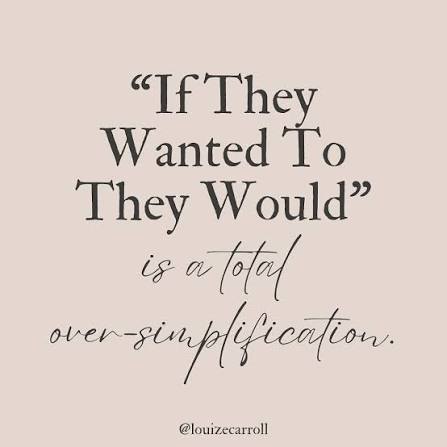
There are certain phrases the internet has collectively decided are therapy.
Protect your peace. or Trust your gut. And one of my personal favorites (eyeroll): “If they wanted to, they would.”
I understand why this phrase appeals to people. It’s simple. It’s decisive. It cuts through excuses.
Someone hasn’t texted you? If they wanted to, they would.
Your partner hasn’t planned a date? If they wanted to, they would.
Your friend hasn’t reached out? If they wanted to, they would.
Your family member hasn’t changed? If they wanted to, they would.
Case closed. Court adjourned. Everyone block their ex. Except there’s one tiny problem.
Human behavior doesn’t actually work that way.
Wanting Something and Doing Something Are Not the Same Thing
Psychology has an entire body of research devoted to something called the intention–behavior gap.
Basically: Humans are remarkably capable of genuinely intending to do something…and then not doing it.
You have probably personally conducted this experiment. You wanted to exercise. You wanted to call your friend back. You wanted to schedule the dentist appointment. You wanted to go to bed earlier. You wanted to stop scrolling. You wanted to bring that package to the post office. You wanted to respond to the text.
And yet. Here we are. Package still sitting by the door.
Research on goal pursuit consistently shows that intentions predict behavior—but imperfectly. More recent meta-analytic work involving hundreds of studies continues to find that planning strategies can help people translate intentions into action.
In other words: Wanting matters.
But wanting alone does not reliably produce behavior. Apparently the human brain did not receive the memo from Instagram.
There Is a Lot Between “Want” and “Do”
Someone can want to do something and also be:
- Afraid.
- Avoidant.
- Overwhelmed.
- Depressed.
- Anxious.
- Exhausted.
- Distracted.
- Ashamed.
- Unsure how.
- Struggling with executive functioning.
- Worried about rejection.
- Experiencing competing priorities.
- Stuck in an old relational pattern.
- Or simply bad at following through.
None of those things automatically means someone secretly doesn’t care.
Human motivation is messy. Sometimes we want two conflicting things at the same time.
- I want closeness AND vulnerability scares me.
- I want to apologize AND I’m ashamed of what I did.
- I want to call my friend AND I’ve waited so long that now calling feels awkward.
- I want this relationship AND conflict makes me shut down.
Both motivations can exist. People contain multitudes. Occasionally very inconvenient ones.
But Here’s Where the Phrase Gets Something Right
Now, before we swing completely in the other direction: I am not suggesting that you explain away someone’s behavior forever because they probably really want to.
Intentions matter. Behavior also matters.
In relationship research, feeling that another person is responsive to us—meaning that they understand us, validate our experiences, and care about our needs—is considered an important part of intimacy.
We don’t experience relationships solely through someone’s internal intentions. We experience what actually happens between us.
Someone may genuinely think: I love you. I care about you. I want to be there for you. And you may simultaneously experience: You aren’t there for me. Those can both be true.
Understanding someone’s reasons doesn’t require pretending their behavior isn’t affecting you.
“They Care” and “This Isn’t Enough” Can Coexist
This is the nuance that gets lost. We tend to want one person to be right.
Either: They don’t care about you. Leave.
Or: They have reasons for behaving this way, so you should understand.
There’s a third option. They may care about me very much, and this relationship may still not be meeting my needs.
Oof. Less satisfying. Much harder to put over a sunset background. But often considerably more useful.
Someone doesn’t have to be cruel, manipulative, narcissistic, secretly terrible, or completely indifferent to you for a relationship not to work.
Sometimes there’s a mismatch between what someone can consistently offer and what you need.
That matters.
Capacity Matters
One of the biggest problems with “If they wanted to, they would” is that it assumes wanting is the only variable.
It isn’t.
Someone may want to communicate differently and not have the skills yet.
Someone may want more emotional intimacy while also finding vulnerability terrifying.
Someone may want to maintain friendships while having very little social energy.
Someone may want to be supportive while having no idea what support looks like to you.
Someone may love you and still have limited emotional capacity.
This doesn’t mean: Therefore, you must accept whatever they give you.
It means: Their limitations aren’t necessarily evidence that their feelings are fake.
Those are very different conclusions.
And Sometimes They Could—but They Don’t
This is also real.
Sometimes someone has the capacity. You’ve communicated what you need. They understand. They’ve had opportunities. They’ve promised change. And the same pattern keeps happening. At some point, endlessly analyzing what someone really wants may not be particularly useful.
Maybe they want to. Maybe they don’t. Maybe they want to in theory. Maybe they want to but not enough to tolerate the discomfort required to change. Maybe they care but aren’t willing to prioritize this.
You may never know. And you don’t necessarily need to.
Instead of asking: “Do they actually care about me?” you might ask: “What does the pattern of this relationship tell me?”
That’s a question you can answer.
Look at Patterns, Not Isolated Moments
One missed text doesn’t tell you how someone feels about you. Neither does one forgotten birthday. One canceled plan. One bad conversation. One moment when someone didn’t respond the way you needed.
Humans are inconsistent. We get tired. We forget things. We misunderstand each other. We occasionally behave like absolute potatoes. Relationships need room for that.
But patterns are different.
If you’ve repeatedly communicated a need and nothing changes, that’s information.
If someone repeatedly makes commitments and doesn’t follow through, that’s information.
If you’re consistently the person initiating, repairing, planning, accommodating, or reaching out, that’s information.
Notice the distinction: Information.
Not necessarily proof of someone’s internal emotional state.
You don’t need to conclude: “They never loved me.”
You can conclude: “This pattern isn’t working for me.”
Stop Trying to Read Their Mind
Ironically, “If they wanted to, they would” is often presented as a way to stop overthinking.
But it still involves mind-reading. They didn’t do X. Therefore: I know what they want. We don’t.
Behavior gives us information about behavior. It doesn’t give us perfect access to another person’s internal world.
A person can fail to call because they don’t care.
A person can also fail to call because they’re anxious.
Or overwhelmed.
Or avoidant.
Or forgot.
Or assumed you were busy.
Or kept thinking, I’ll call tomorrow, until three weeks passed and now they’re trapped inside an increasingly ridiculous social-anxiety situation of their own creation.
Same behavior. Different internal experiences.
Try This Instead
When you catch yourself thinking: “If they wanted to, they would,” try replacing it with a few different questions.
What am I actually observing?
Separate behavior from interpretation.
Instead of: They don’t care.
Try: I’ve initiated our last six conversations.
Then ask: Is this an isolated incident or a pattern?
Next: Have I communicated what I need?
Not hinted. Not hoped they would figure it out. Not conducted an elaborate secret test they did not know they were taking. Actually communicated it.
Then: What happens after I communicate it?
Do they listen? Get curious? Try? Follow through? Take responsibility when they don’t? Do things change over time?
And finally: Regardless of why this is happening, does this relationship work for me?
That’s often the most important question.
Responsiveness Matters More Than Mind-Reading
Relationship research gives us a better concept than: If they wanted to, they would.
It’s responsiveness. Responsiveness is about whether we experience another person as understanding, validating, and caring about our needs. That doesn’t require perfection.
- A responsive partner can forget something.
- A responsive friend can take too long to text back.
- A responsive family member can misunderstand you.
What matters is what happens in the relationship over time.
- Can you communicate?
- Can you repair?
- Can the other person hear your needs?
- Do they make meaningful efforts to respond?
- Do their actions generally communicate care?
That gives us much more useful information than trying to determine whether one particular behavior proves how much someone wanted something.
Sometimes Love Isn’t the Problem
This can be one of the hardest things to accept:
- Sometimes people genuinely love each other and still can’t create a healthy relationship together.
- Sometimes a parent loves their child and still causes harm.
- Sometimes a friend cares deeply and still isn’t capable of the kind of friendship you need.
- Sometimes someone wants to change and doesn’t.
- Sometimes someone loves you and repeatedly disappoints you.
Love is meaningful. But love isn’t the only requirement for a functioning relationship.
- Capacity matters.
- Communication matters.
- Compatibility matters.
- Responsiveness matters.
- Accountability matters.
- Behavior matters.
A Better Version
So maybe instead of: “If they wanted to, they would,” we say: “What someone wants matters. What they consistently do matters too.”
Or: “You don’t have to decide that someone doesn’t care about you in order to decide that their behavior isn’t enough for you.”
I like that one much better. Because we don’t have to flatten another human being into: They would if they cared. And we don’t have to flatten ourselves into: If they care, I have to keep accepting this.
We can hold both. Maybe they wanted to. Maybe they really did. And maybe what they were able or willing to offer still wasn’t what you needed.
Understanding someone’s behavior and accepting that behavior are not the same thing.
Look at the pattern. Communicate your needs. Pay attention to what happens next. And make decisions based on the relationship you’re actually experiencing— not the one you’re trying to prove exists inside someone else’s head.
References
Arican-Dinc, B., & Gable, S. L. (2023). Responsiveness in romantic partners’ interactions. Current Opinion in Psychology, 53, 101652. doi:10.1016/j.copsyc.2023.101652
Gollwitzer, P. M., & Sheeran, P. (2006). Implementation intentions and goal achievement: A meta-analysis of effects and processes. Advances in Experimental Social Psychology, 38, 69–119. doi:10.1016/S0065-2601(06)38002-1
Itzchakov, G., Reis, H. T., & Weinstein, N. (2022). How to foster perceived partner responsiveness: High-quality listening is key. Social and Personality Psychology Compass, 16(1), e12648. doi:10.1111/spc3.12648
Keller, L., Bieleke, M., & Gollwitzer, P. M. (2024). The when and how of planning: Meta-analysis of the scope and components of implementation intentions in 642 tests. European Review of Social Psychology, 36(1), 162–194. doi:10.1080/10463283.2024.2334563
Sheeran, P. (2016). Intention–behavior relations: A conceptual and empirical review. Social and Personality Psychology Compass, 10(9), 503–518. doi:10.1111/spc3.12265
