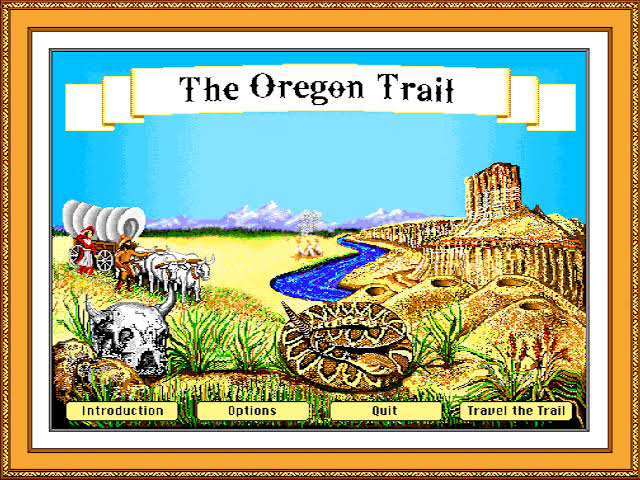
A Quick Note Before You Read: This post has a little fun with millennial nostalgia, but you definitely don’t have to be a millennial – or have ever died of dysentery on the Oregon Trail – to relate to it. The bigger theme is about navigating adulthood in a world that often looks very different from the one we were prepared for. Whether you’re 20, 40, 60 or somewhere in between, I think there’s something here that may feel familiar.
If you are a millennial, there is a decent chance that at some point during your childhood you were placed in front of a computer and entrusted with the survival of an entire family traveling west in a covered wagon.
This was education.
You bought oxen.
You purchased supplies.
You crossed rivers.
You hunted.
You made important decisions about food rations.
And inevitably: Someone died of dysentery.
It didn’t matter how carefully you planned.
You could have twelve oxen, plenty of food, excellent pacing, and the confidence of a seasoned pioneer.
The Oregon Trail had other plans.
Looking back, perhaps this was better preparation for adulthood than we realized. Because many millennials entered adulthood believing that if we made reasonably good choices, worked hard, and followed the instructions, things would generally go according to plan. And then adulthood said: Would you like to ford the river or caulk the wagon and float across?
Excuse me? I was told there would be a syllabus.
We Were Raised to Believe There Would Be Instructions
Think about how much of childhood and adolescence involved knowing what came next.
You finished one grade. Then you went to the next. There was a schedule. Assignments had due dates. Tests had study guides. You completed the requirements. Someone told you whether you passed. Even college usually had a degree plan. Take these classes. Earn this many credits. Complete these requirements. Graduate.
Then adulthood arrives and suddenly:
- What career should you choose?
- Where should you live?
- Should you get married?
- Should you have children?
- How much should you save for retirement?
- When should you buy a house?
- Should you buy a house?
- How do you know when to leave a relationship?
- How do you choose health insurance?
- What exactly is an escrow account?
- Why is the dishwasher making that sound?
- And perhaps most offensively: You are now responsible for scheduling your own dentist appointments.
There is no syllabus. Nobody is grading this. And somehow that makes it worse.
We Thought Adults Knew What They Were Doing
One of the stranger discoveries of adulthood is realizing: Oh. Everyone is just making decisions with the information they currently have.
As children, adults seemed like a separate species.
They knew how taxes worked.
They knew where we were going.
They knew when to leave the house.
They understood insurance.
They could call a doctor’s office without rehearsing the conversation first.
Then you become an adult and discover that someone can have:
A career.
A mortgage.
Three children.
A retirement account.
And still Google: “How long is chicken good in the fridge?”
This is simultaneously comforting and horrifying.
There Is No Perfect Route
In The Oregon Trail, every decision carried uncertainty.
Take the shortcut?
Wait?
Rest?
Keep moving?
Cross the river?
Pay for the ferry?
You could make a perfectly reasonable choice and still get a terrible outcome.
Welcome to adulthood.
We often want decisions to work differently. We want enough information to guarantee that we’re choosing correctly.
If I take this job, will I like it?
If I move, will I regret it?
If I end this relationship, will I wish I hadn’t?
If I stay, will things get better?
If I have children, will I be happy?
If I don’t, will I regret it?
If I spend the money, will I need it later?
If I say no, will they be upset?
So we research. Think. Ask people. Make lists. Research again. Ask another person. Open seventeen browser tabs. Create a spreadsheet. Consult Reddit. Reopen the spreadsheet.
At some point, information gathering quietly becomes an attempt to eliminate uncertainty.
Unfortunately: There is no amount of planning that turns an uncertain decision into a guaranteed outcome.
Sometimes You Make the Right Decision and Still Get a Bad Outcome
This is an important distinction. Our brains love evaluating decisions based on what happened afterward.
Bad outcome? Must have been a bad decision.
But that’s not always true.
You can carefully evaluate a job and still end up with a terrible manager.
You can choose a relationship with the information available and later discover something you couldn’t have known.
You can make a financially reasonable decision right before the economy changes.
You can take care of your health and still become ill.
You can set a thoughtful boundary and lose a relationship.
You can prepare. Plan. Ask good questions. Make a reasonable choice. And still encounter something difficult.
Sometimes you chose poorly.
And sometimes: Your wagon wheel broke.
Those are not the same thing.
Millennials Have Had a Few Wagon Wheels Break
Without turning this into a history lecture, millennials have navigated quite a few large-scale disruptions during major developmental periods.
The September 11th attacks occurred while many of us were children, teenagers, or young adults.
Then came wars that lasted much of our adolescence and early adulthood.
The Great Recession hit as older millennials were beginning careers and younger millennials were approaching adulthood.
Many entered adulthood with substantial student loan debt.
Housing affordability became increasingly difficult.
Then COVID-19 arrived while many millennials were establishing careers, raising young children, deciding whether to have children, caring for parents, buying homes, building relationships, or otherwise attempting to construct stable adult lives.
And somewhere in there, smartphones and social media fundamentally changed how humans communicate, work, compare ourselves, consume news, and remain accessible to one another.
So if adulthood has occasionally felt less stable than you expected? You didn’t imagine that. There have been a few river crossings.
Adaptability Is a Skill We Don’t Give Ourselves Enough Credit For
When we think about resilience, we often picture someone enduring something enormous. But resilience is also: Well. That didn’t work. What now?
Changing jobs.
Learning new technology.
Adjusting expectations.
Rebuilding after a breakup.
Moving.
Starting over financially.
Changing careers.
Finding new community.
Learning how to work from home.
Learning how to work around other people again.
Changing how you relate to family.
Realizing a goal no longer fits.
Creating a different plan.
Asking for help.
Trying again.
Resilience isn’t necessarily being unaffected by change. It is often the ability to adapt while being very affected by change. You can be struggling and adapting at the same time.
“I Should Know How to Do This by Now”
This sentence causes so much unnecessary shame. I hear variations of it constantly.
“I’m an adult. I should know this.” Okay. Who taught you? Seriously. Where exactly were you supposed to learn it?
There are countless adult tasks we are simply expected to absorb through the atmosphere.
Managing money.
Navigating insurance.
Maintaining a home.
Handling conflict.
Setting boundaries.
Recognizing unhealthy relationships.
Managing emotions.
Parenting.
Caring for aging parents.
Grieving.
Advocating for yourself medically.
Understanding retirement.
Communicating needs.
Knowing when to rest.
Knowing when to push yourself.
Knowing when to leave.
Knowing when to stay.
Then we struggle with one of these things and decide the problem is: “Something is wrong with me.”
Sometimes you aren’t failing at something you should know. Sometimes you’re learning something nobody taught you.
Adulthood Has an Incredible Number of Side Quests
Nobody adequately explained this part.
You wake up thinking: Today I will work and then relax.
Incorrect.
You need to call the insurance company because they billed something incorrectly.
Your car has developed a light.
The dog needs medication.
Your credit card was compromised.
You need a birthday gift by Saturday.
There is a form you forgot to complete.
Something in the house is leaking.
Your prescription requires prior authorization.
You need to figure out whether the email claiming to be from your bank is actually from your bank.
Also: What are we having for dinner?
Again.
We just did dinner yesterday.
Adulthood requires an enormous amount of cognitive labor that doesn’t necessarily look like accomplishment. Planning. Remembering. Scheduling. Monitoring. Deciding. Following up. Coordinating. Switching attention.
These tasks consume mental resources. So sometimes when you think: “Why am I exhausted? I didn’t even accomplish that much today.” the answer may be: You were mentally managing seventeen side quests while attempting to complete the main storyline.
Decision Fatigue Is Real
Adulthood also involves an astonishing number of decisions.
What are we eating?
When should I schedule this?
Can I afford that?
Should I answer this now?
Which insurance plan?
Do I need to go to the doctor?
Should I say something?
Do we repair this or replace it?
Should I go?
Should I cancel?
When do I have time?
Some decisions are trivial. Others have meaningful consequences. But they all require some degree of cognitive effort.
Research on decision fatigue is more nuanced than the internet sometimes makes it sound, and we shouldn’t assume that every difficult choice is simply the result of a depleted “decision-making battery.” But feeling cognitively overloaded by repeated choices is very real. This is one reason routines can be helpful. Not because everyone needs an aggressively optimized morning routine involving lemon water and a 4:45 a.m. cold plunge. But because sometimes: I always take my medication after brushing my teeth is one less decision. Tuesday is grocery day is one less decision. I don’t answer work messages after this time is one less decision.
Structure can reduce how often you have to reinvent your life from scratch.
Sometimes You Need to Rest the Party
In The Oregon Trail, pushing forward wasn’t always the best option. Sometimes your party needed rest. Millennials appear to have forgotten this feature.
We tend to treat slowing down as something that happens after everything is finished.
Work first.
Then chores.
Then errands.
Then responsibilities.
Then emails.
Then everyone else’s needs.
Then perhaps, if the stars align:
Rest.
Except the responsibilities regenerate. They are apparently renewable resources. Rest isn’t the prize you receive for successfully completing adulthood. Recovery is part of maintaining the ability to continue. Sometimes the strategic move really is: Rest for two days.
Your productivity committee may object. The wagon continues to wait.
You Cannot Carry Every Supply
Another lesson from The Oregon Trail: Resources are limited. You couldn’t take everything.
Adult life works similarly. Time is limited. Money is limited. Energy is limited. Attention is limited. Emotional capacity is limited. You cannot simultaneously:
- Excel professionally.
- Maintain every friendship.
- Exercise daily.
- Keep an immaculate house.
- Cook every meal.
- Sleep eight hours.
- Care for family.
- Volunteer.
- Maintain hobbies.
- Answer every message.
- Attend every event.
- Process all your trauma.
- Drink 64 ounces of water.
- And keep up with whatever television show everyone is currently insisting you need to watch.
Something will receive less attention. That’s not necessarily poor time management. Sometimes it’s mathematics. The question becomes: Given the resources I have right now, what matters most?
Sometimes the Pace Needs to Change
There were pacing options in The Oregon Trail.
Steady.
Strenuous.
Grueling.
Many adults appear to have selected: Grueling and then forgotten it was a setting.
You can move quickly for periods of time. Sometimes life requires it. Deadlines happen. Emergencies happen. Busy seasons happen. But grueling isn’t supposed to become your permanent pace.
If your life only works when you are consistently sacrificing sleep, ignoring your body, postponing rest, and functioning at maximum capacity, the problem may not be that you need better discipline. The pace itself may be unsustainable.
You Don’t Have to Prepare for Every Possible Disaster
The anxious brain loves preparedness.
What if this happens? Okay, let’s make a plan.
What about this? Another plan.
And this? Plan.
Eventually you’ve spent three hours preparing for twelve hypothetical disasters and zero minutes living your actual Tuesday.
Preparation can be useful. Anxiety’s trick is convincing us that if we prepare thoroughly enough, uncertainty will disappear. It won’t. At some point, we have to shift from: “How do I make sure nothing goes wrong?” to: “How do I trust myself to respond if something does?” That’s a very different kind of confidence.
It isn’t: I know what’s going to happen. It’s: I don’t know what’s going to happen, and I believe I can figure out the next step.
Maybe That’s What Being an Adult Actually Is
Perhaps adulthood isn’t finally reaching the point where you know what you’re doing. Maybe it’s developing enough experience to think: I have absolutely no idea what to do here followed by: Okay. Let’s figure it out.
Ask someone. Look it up. Call the professional. Try something. Make a decision. Correct course. Apologize. Start over. Rest. Learn. Continue. That’s competence too.
You don’t have to already know the answer to be capable of finding one.
An Oregon Trail Check-In
When life feels like one giant list of problems you should somehow already know how to manage, try asking: What is actually happening right now? Not every hypothetical disaster. Right now.
What resources do I have? Time? Money? Knowledge? Support? Energy? Professional help?
What is the next decision? Not the next seventeen. The next one.
What can wait? Everything does not have equal urgency.
Do I need to keep moving, slow down, or rest?
And finally: Am I trying to make a good decision—or am I trying to guarantee a good outcome? Because those are not the same thing.
The Oregon Trail Did Not Prepare Us for This
We spent childhood trying to keep imaginary pioneers alive.
Nobody mentioned: Insurance deductibles. Student loans. Work-life balance. Boundaries. Caregiving. Burnout. Career changes. Housing markets. Group texts. Retirement planning. Prior authorizations. Or the fact that you can apparently spend $200 at the grocery store and still have nothing to make for dinner.
The Oregon Trail did not prepare us for this. Neither did most of the adults around us, because the world we entered wasn’t exactly the world they entered either.
So maybe the goal isn’t becoming an adult who finally has everything figured out.
Maybe it’s becoming someone who can tolerate not knowing.
Someone who can make a reasonable decision without a guarantee.
Someone who can change course when new information arrives.
Someone who recognizes when resources are low.
Someone who knows when it’s time to keep moving.
And when it’s time to rest the party.
You will make mistakes. Things will break. Plans will change. Some river crossings will go poorly. Occasionally, despite your best efforts, life will inform you that an ox has wandered away.
You don’t have to know the entire route. You just have to figure out what makes sense from here. And preferably avoid dysentery.
References
Bonanno, G. A. (2004). Loss, trauma, and human resilience: Have we underestimated the human capacity to thrive after extremely aversive events? American Psychologist, 59(1), 20–28. https://doi.org/10.1037/0003-066X.59.1.20
Bonanno, G. A., & Burton, C. L. (2013). Regulatory flexibility: An individual differences perspective on coping and emotion regulation. Perspectives on Psychological Science, 8(6), 591–612. https://doi.org/10.1177/1745691613504116
Kashdan, T. B., & Rottenberg, J. (2010). Psychological flexibility as a fundamental aspect of health. Clinical Psychology Review, 30(7), 865–878. https://doi.org/10.1016/j.cpr.2010.03.001
Sonnentag, S., Cheng, B. H., & Parker, S. L. (2022). Recovery from work: Advancing the field toward the future. Annual Review of Organizational Psychology and Organizational Behavior, 9, 33–60. https://doi.org/10.1146/annurev-orgpsych-012420-091355
Southwick, S. M., Bonanno, G. A., Masten, A. S., Panter-Brick, C., & Yehuda, R. (2014). Resilience definitions, theory, and challenges: Interdisciplinary perspectives. European Journal of Psychotraumatology, 5(1), 25338. https://doi.org/10.3402/ejpt.v5.25338
